


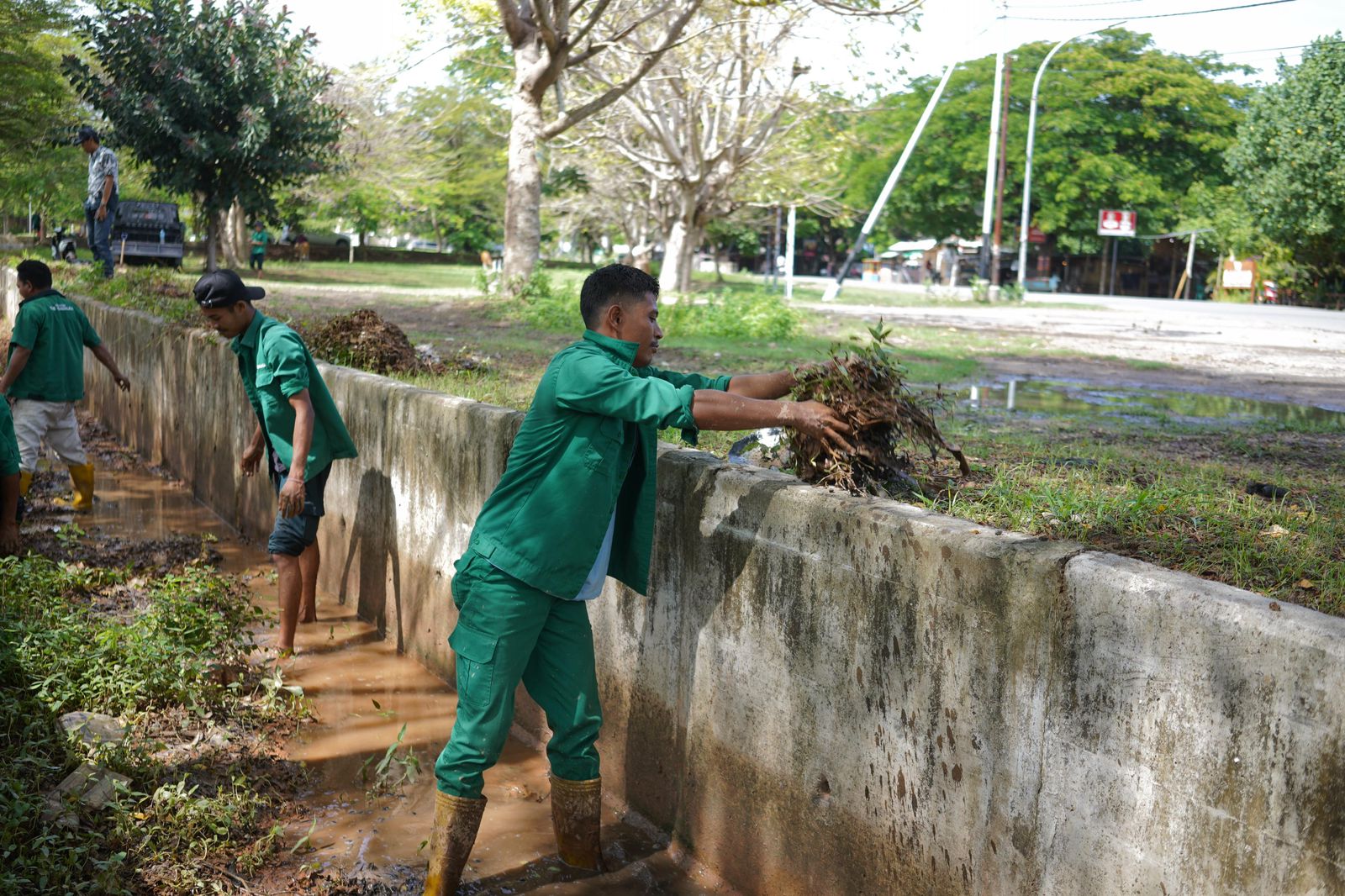
ibnchannel.id – Entering the rainy season, InJourney Tourism Development Corporation (ITDC), a member of the InJourney Group, is strengthening its environmental management efforts in the Mandalika Special Economic Zone (SEZ) by cleaning drainage channels throughout the area’s operational zone. This step is ITDC’s effort to ensure the water management system functions optimally, reduce the risk of inundation and potential sedimentation, maintain the cleanliness of the area, and guarantee the sustainability of infrastructure supporting the tourism destination.
The drainage cleaning, which started on Tuesday (4/11), will continue until the entire drainage network is declared clean. The main focus of the cleaning is on the Western Zone of The Mandalika SEZ, which has the longest drainage network and serves as the main route for water flow from the area to the final discharge point. Normalization is carried out by cleaning the channels of trash, mud deposits, and shrubs that could potentially impede water flow, using heavy equipment and supporting vehicles.
Based on field monitoring, throughout October 2025, the volume of mud deposits and trash increased by about 10 percent compared to the previous month. This increase is due to the rising intensity of rain and land-use change in the upstream section and around the area, which has resulted in high sedimentation in the drainage channels. ITDC then accelerated the drainage normalization at a number of priority points, involving 89 combined personnel from the gardener team, cleaning team, operational team, and fire department, assisted by operational trucks for transport.
PGS. General Manager of The Mandalika, Agus Setiawan, stated that this activity is ITDC’s commitment to maintaining environmental sustainability and a standby action to face the dynamics of extreme weather during the rainy season. “We ensure that all supporting infrastructure in the area, including the drainage channels, is in prime condition so that the water management function continues to run well even if rainfall increases. This step is a form of ITDC’s operational readiness to minimize the risk of waterlogging and support the implementation of sustainability principles in the tourism destination,” Agus said.
The drainage system in the Mandalika SEZ is designed with an open pattern connected to several catchment areas and a final discharge route in the southern part of the area. This design allows rainwater to be channeled efficiently towards the discharge point, while also serving as a surface runoff control system. To maintain the system’s performance, ITDC routinely maintains and cleans the channels to ensure the water holding capacity remains stable and prevent sedimentation that could impede flow.
The drainage cleaning is an implementation of ITDC’s Environmental Management program, which is carried out continuously. This program includes various initiatives such as area greening, integrated waste management, and erosion control in the vicinity of the tourism area. This aligns with the information from the Meteorology, Climatology, and Geophysics Agency (BMKG) which stated that the West Nusa Tenggara region entered the start of the rainy season from late October to early November 2025, with medium category rainfall intensity in the southern part of Lombok Island.
Through these environmental management measures, ITDC contributes to achieving the Sustainable Development Goals (SDGs), particularly in supporting sustainable clean water and sanitation management (SDG 6), developing climate-resilient areas (SDG 11), and mitigating environmental impacts (SDG 13). This approach affirms ITDC’s role as a sustainable tourism developer that consistently integrates environmental aspects into every operational policy of the area.
“Through this effort, ITDC is committed to ensuring that the Mandalika SEZ is not only a leading tourist destination but also an example of a sustainable tourism area that is adaptable to environmental changes. We want to ensure that every operational step in this area is always in line with the principles of ecosystem sustainability in its surroundings,” Agus concluded.***


